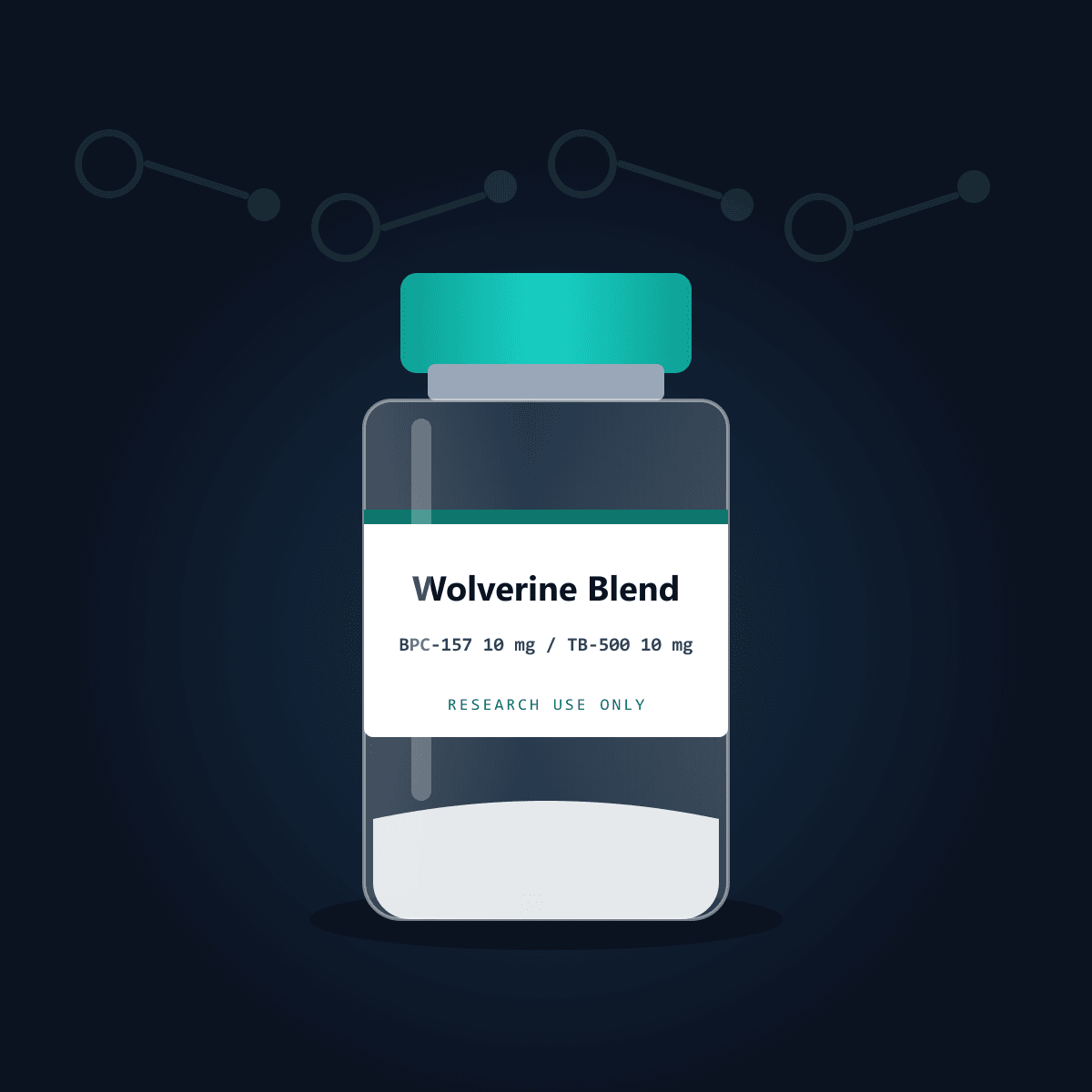
Lyophilization, usually called freeze-drying, is the standard way of turning a purified peptide solution into a dry solid. After synthesis and HPLC purification, the peptide is dissolved in water (often with a small amount of acetic acid or acetonitrile), frozen, and then placed under vacuum so that the ice converts directly to vapour without passing through a liquid phase.
How the process works
Freeze-drying runs in three stages:
- Freezing. The solution is cooled well below its freezing point so that water forms ice crystals and the peptide is concentrated between them.
- Primary drying. Pressure is lowered and gentle heat is applied to the shelf. Ice sublimes and is collected on a cold condenser. Most of the water is removed at this stage.
- Secondary drying. The temperature is raised slightly to drive off water that is bound to the solid. This brings residual moisture down to a low level.
The result is a white to off-white powder or "cake". In small vials the material can look like a thin film or may be barely visible, which is normal for milligram quantities.
Why it matters in the lab
Peptides in solution are vulnerable to hydrolysis, oxidation and microbial growth. Removing water slows those processes considerably, so a lyophilized peptide kept sealed, cold and dry can remain within specification far longer than the same material in solution. It also allows the product to travel without a continuous freezer chain, although we still ship in insulated packaging. Volatile components of the purification buffer are largely removed during drying, which is why many peptides are isolated as a TFA salt.
Handling lyophilized vials
- Store unopened vials at -20 °C or below, protected from light and moisture.
- Let a vial reach room temperature before opening it, so that condensation does not form on the cold powder.
- Prepare solutions only as needed, divide them into single-use aliquots and avoid repeated freezing and thawing.
- Record the batch number and the date the vial was first opened.
For a fuller explanation of storage conditions and how different sequences behave, read our guide to peptide storage and stability. Products such as Neurotensin and Kisspeptin-10 are supplied lyophilized with storage guidance on the label.